.jpg)
Rashtrapati Bhavan
Built with a mix of Western and Indian styles, Rashtrapati Bhavan was originally built for the Governor General Of India, aka Viceroy of India. Inaugurated in 1931 as the Viceregal Lodge, the name was changed in 1950 after India became a republic.
 Akshardham Temple(Delhi)
- A recent addition to Delhi's gems, this monument, inaugurated in November 2005, is contending to be among the best sights to see in Delhi.
Qutb Minar
The Qutb Minar is located in a small village called Mehrauli in South Delhi. It was built by Qutb-ud-din Aybak of the Slave Dynasty, who took possession of Delhi in 1206. It is a fluted red sandstone tower, which tapers up to a height of 72.5 metres and is covered with intricate carvings and verses from the Qur'an. Qutb-ud-din Aybak began constructing this victory tower as a sign of Muslim domination of Delhi and as a minaret for the Muslim priest, the muezzin, to call the faithful to prayer. However, only the first story was completed by Qutb-ud-din. The other storys were built by his successor Iltutmish. The two circular storys in white marble were built by Ferozshah Tughlaq in 1368, replacing the original fourth story.
At 72.5 meters, the 13th century Qutb Minar is the world's tallest brick minaret.
The balconies in the tower are supported by exquisite stalactite designs. The tapering tower has pointed and circular flutings on the first story and star-shaped ones on the second and third stories. The bands of calligraphic inscriptions are amazing in their perfection along the exquisite stalactite designs on the exterior of this tower.
The Qutb Minar, apart from being a marvel in itself, is also significant for wha t it represents in the hist ory of Indian culture. In many ways, the Qutb Minar, the first monument built by a Muslim ruler in India, heralded the beginning of a new style of art and architecture that came to be known as the Indo-Islamic style.
Red FortWhen one a

pproaches old Delhi with a somewhat Westernised perception, the emotional response can range from wonderment to bewilderment, from utter disgust to ecstasy. Old Delhi gives an insight into the multi-layered identity that so aptly characterizes India. The lanes are narrow, fille d to bursting with people, and throbbing with life. In the midst of this sea of people, suddenly you come face to face with the ramparts of the Red Fort.
The decision for constructing the fort was made in 1639, wh en Shah Jahan decided to shift his capital from Agra to Delhi. Within eight years, Shahjahanabad was completed with the Red Fort-Qila-i-Mubarak (fortunate citadel) — Delhi's seventh fort — ready in all its magnificence to receive the Emperor. Though much has changed with the large-scale demolitions during the British occupation of the fort, its important structures have survived, the glory faded with age but still impressive.
Jama Masjid
The Masjid-i-Jahan Numa, commonly known as Jama Masjid, is the principal mosque of Old Delhi. Commissioned by the Mughal Emper or Shah Jahan and completed in the year 1656 AD, it is one of the largest and best known mosques in India.
 Bahá'í House of Worship (Lotus Temple)
The Bahá'í temple in Delhi, India was completed in 1986 and serves as the Mother Temple of the Indian Subcontinent. It has won numerous architectural awards and been featured in hundreds of newspaper and magazine articles. The architect was an Iran ian who now lives in Canada, named Fariborz Sahba.
Inspired by the lotus flower, its design is composed of 27 free-standing marble clad "petals" arranged in clusters of three to form nine sides.
Purana Quila (Old Fort)
The Old Fort, also known as the Purana Qil'ah or Purana Killa in Hindi and Urdu, i s one of the most famous monuments in Delhi, India and is its oldest historical site. The fort was constructed in the 16th-century by the founder of the Sur Dynasty, Sher Shah Suri. The fort's unique Mughal-Hindu-Afghan architecture makes it a popular tourist destination in Delhi. However, in recent years, the fort has also attracted a lot of attention of archaeologists. Recent archaeological evidence suggests that the historic city of Indraprastha once sto od where the Old Fort is today.
Today, the Old Fort houses the Delhi Zoo, Delhi's largest zoological park, and a boat club . The historic structure of the Purana Qila has stood witness to the restoration of the city of Delhi, the periods of anarchy, and the rise and fall of empires.
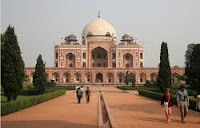 Humayun's Tomb
Humayun's Tomb was built by Humayun's widow, Hamida Banu Begum. Designed by a Persian architect named Mirak Mirza Ghiyas, the structure was begun in 1562 and completed in 1565. The tomb established a stand ard for all later Mughal monuments, which followed its design, most notably the Taj Mahal.
India Gate
Situated along the ceremonial Rajpath avenue (meaning King's Way) in New Delhi, India Gate is a memorial raised in honour of the Indian soldiers who died during the Afghan wars and World War I. The names of the soldiers who died in these wars are inscribed on the walls. The cenotaph (or shrine) in the middle is constructed with black marble and depicts a rifle placed on its barrel, crested by a soldier's helmet. Each face of the cenotaph has inscribed in gold the words Amar Jawan (in Hindi, meaning Immortal Warrior). The green lawn s at India Gate are a popular evening and holiday rendezvous for young and old alike.

Birla Mandir
Birla Mandir, also known as Laxminarayan temple,is among the most popular of Hindu temples in Delhi.The temple was inaugurated by Mahatma Gandhi in 1938 on the condition that people of all strata of society be allowed to offer prayers there on account of the largescale prevalence of untouchability at that time. Built by the well-known industrialist, R.D. Birla, the temple is dedicated to Laxmi ( the goddess of wealth) and Narayana( the preserver). One of the most important festivals of the Hindus Janamashtami coinciding with the birth of Lord Krishna is celebrated with great fervour in the temple and the occasion is visited by lakhs of devotees.At the entrance is a plaque which welcomes people of all faiths and religions to visit the temple and that there would be no ostracisation of any kind.
Jantar Mantar

The Yantra Mandir (literally the 'temple of instruments', and often called the Jantar Mantar) is in the modern city of New Delhi, Delhi. It consists of a collection of architectural astronomy instruments, built by Maharaja Jai Singh II of Jaipur, for his own use, from 1724 onwards. The primary purpose of the observatory was to compile astronomical tables, and to predict the times and movements of the sun, moon and planets. Some of these purposes nowadays would be classified as astrology.
Jai Singh later had another similar observatory, now known by the same name, built for him at Jaipur. Today the observatory is mainly a tourist attraction, and is significant in the history of astronomy.
Dilli HaatDilli Haat is a combination food plaza and craft bazaar located in

the heart of Delhi. Near All India Institute of Medical Sciences, opposite INA Market Dilli Haat has stalls representing each State of India, giving complete variety of tastes available all over India. There are also stalls of crafts from all over India, from a variety of cultural traditions of India. Around 2003, this market became fully wheelchair-accessible, including an accessible bathroom.This is a relative rarity in India.There are plans to open more Dilli Haats all over Delhi.
Unlike the traditional weekly market, the village Haat, Dilli Haat is permanent. Some shops are permanent but other sellers are rotatated, usually for fifteen days.Products offered may include rosewood and sandalwood carvings, embellished camel hide footwear, sophisticated fabric and drapery, gems, beads, brassware, metal crafts, and silk and wool fabrics. Shows promoting handicrafts and handlooms are held at the exhibition hall in the complex. To sell wares, there is an application process and spaces are allocated according to which state the seller is from.
Deer ParkDeer Park is located in Delhi. Popular with morning walkers, it is approachable from Hauz Khas Village, Safdarjang Enclave, or near the courts side of the Delhi Lawn Tennis Association. The park also has huts where people can stay.

.jpg)


